
Wednesday, January 19, 2022

The Arts and a sustainable future

 For the past few years I've belonged to a group of lawyers, academics, businesspeople and former politicians that meets once a month to engage in friendly debates. They call themselves the 'Muddy York Debating Society.' 


A few months back I was invited to debate on the subject of "Are the Arts essential to a sustainable future?" I argued in the affirmative. Here's what I said:


******

 
As we all know, these debates always come down to definitions, and lawyers love to play with definitions. As they told us in law school, definitions make the difference between fly poop and pepper.
 

“The Arts are essential to a sustainable future.” The three key words for definition in this short sentence are “arts”, “essential” and “sustainable”. Let’s deal with each of them.


In common parlance, “sustainability” has become just another sociological and feel-good marketing flim-flam. Your yoga mat has to be made of “sustainable” materials. Your morning coffee has to be “sustainable”. Your investment portfolio has to be composed of “sustainable” investments in “sustainable” corporations. Like “organic”, ‘fair trade” or “free-range’, “sustainable” has become all but meaningless, making a debate about whether something is “sustainable” as slippery as a politician’s promise.


A good working definition of sustainability is the capacity to endure in a relatively ongoing way across various domains of life. It has a narrow environmental meaning, but sustainability is larger than that.


But if we go back to the simplest meaning of the word – enduring – then there is no doubt that the arts are the most enduring and therefore sustainable part of the human past, and therefore of our future.


Art. What is art? Is it like pornography – we know it when we see it? Or is it defined in the negative? As The Edge of U-2 once commented, "We don't know what it is, so it must be art." Leaving aside such philosophical questions, the seven arts are traditionally agreed to be: Architecture, Sculpture, Painting, Music, Poetry, Dance, and Performing.


When we look at the long story of recorded human history, what is it that endures? Art. The oldest known cave painting is a red hand stencil in a cave in Spain. It has been dated to older than 64,000 years. In fact, it isn’t even human – it was  made by a Neanderthal. In the end, Neanderthals were not sustainable, but their art was. It endured longer than they did.


Architecture is one of the most enduring and therefore sustainable of the arts. We can still stand on pyramids and ziggurats built thousands of years ago. Egypt's Old Kingdom era tombs were constructed some 4,500 years ago, making the mosaics of Pompeii look positively youthful at only 1900 years old.  We can still stand in the Roman Forum and Nero’s box at the Coliseum. We can still shop and discuss at the Acropolis at Athens and the Agora, from the 5th century BC, where Plato and Aristotle taught.


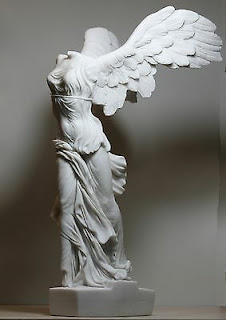
Sculpture. How many people have stood before the Venus de Milo, or the Winged Victory? The Venus de Milo was sculpted sometime between 150 and 125 BC. The Winged Victory of Samothrace dates from 200 BC. Both are mere babies compared to Venus of Hohle Fels, an Upper Paleolithic Venus figurine made of mammoth ivory dated to between 40,000 and 35,000 years ago. It is the oldest undisputed example of a depiction of a person. This isn’t even Neanderthal – it is from the beginning of the Upper Paleolithic from the earliest presence of Cro-Magnon in Europe. Now that’s sustainable.


I mentioned Plato and Aristotle. We can still read their literature – along with other plays and philosophies of Ancient Greece. The Histories of Herodotus is considered the founding work of history in Western literature written almost 2500 years ago. Who hasn’t struggled through Chaucer, or Spenser’s Fair Queen, or Beowulf? Literature is an enduring art.


Poetry is one of the seven arts, from Homer’s 8th century Iliad and the Odyssey, to the Song of Solomon, and TS Elliot’s Love Song of J. Alfred Prufrock. For those who think poetry is dead art form, consider National Youth Poet Laureate Amanda S. C. Gorman, who spoke at the inauguration of US President Joe Biden, and moved a nation with the power of her poetry.


Performing: Who among us didn’t have to read Antigone, one of Sophocles's trilogy of plays written in 441 BC. The Roman historian Livy wrote that the Romans first experienced theatre in the 4th century BC, with a performance by Etruscan actors. The Greeks had theatres centuries before that. Shakespeare entertained packed houses 400 years ago, and continues to today. In fact, there are no fewer than 525 feature films which give William Shakespeare some form of writing credit - although no royalties - including The Lion King and West Side Story. No doubt people acted out the hunt around campfires since the origins of the human race. Mozart, Wagner and Verdi still draw crowds. Theatre and performances are one of the great communal activities humans enjoy – and one we have sorely missed during Covid. Surely the performing arts are “sustainable”.


Sustainable may also include the idea of relevant or relatable. Can we relate to ancient art? Can we see ourselves and our humanity in art from persons and civilizations long dead? Yes. It still moves us.


Lastly, let’s look at “essential,” as in “the arts are essential to a sustainable future.” The essentialness of the arts is proven by its very endurance. That it has been present since literally before we were human proves its essential nature to our humanity. It is clear to see that creating art is a natural, innate, primal behavior. Children instinctively make art. It exists in every culture. It is a fundamental human behavior. It is part of who we are.


Art is an essential part of human communication. It helps us share ideas, emotions and concepts that are otherwise difficult to express in words. Art extends the way we are able to communicate.


There is a contemplative and spiritual aspect to art that transcends ordinary communications. Some would argue that it allows us to connect with the divine. Jung thought the artist was “one who carries and shapes the unconscious, psychic life of mankind.”  Freud, argued that it taps into deeper human psychological forces that allow us to better understand ourselves. Aristotle believed that art purges the soul of dangerous thoughts and gives a pleasurable relief to the strongest of emotions. It is cathartic.


Art is a history lesson, an historical record, a preservation of culture, and a human autobiography all in one.  Art reflects cultural values, beliefs and identity, and records our own lives and experiences over time. Surely that is essential. It is not only sustainable – its sustains us.


Experiencing and creating art is a social activity, whether we fight through the crowds to catch a glimpse of the Mona Lisa, sit at an opera, ballet, play or concert. Being part of an audience connects us not just to the art but to each other. As social animals, this connectiveness is indeed essential.


What would our future be without the arts? It is impossible to imagine. Humans have always been creative. There is a deeply ingrained impulse to create and share, tell stories, build monuments, sing and compose. The question is, can there even be a future without the arts?


You get it – the arts are old. From an unknown Cro Magnum man or woman carving a fertility goddess from mammoth ivory 35,000 years ago to Picasso and Banksy. But remember that we are now living in their future. In some cases, their distant future. That is proof that the arts have been and are sustainable, and there is no reason to think that they will not be in our future as well.


One of the things the arts have been used for is to help us imagine the future. From Thomas More’s Utopia to Star Trek, authors, painters, actors, and movie makers have created a vision of the future. They have imagined flying cars and moving sidewalks, rocketships and alien races. They have also imagined perfect societies, and more recently a raft of dystopian worlds. These stories help us ease into the future and spur us on to discoveries and technological breakthroughs. They also use futuristic settings to teach us lessons about ourselves – often they are parables about race and war and environmental degredation. They also show us the consequences of taking the wrong path – about futures that are not sustainable.


To use the most narrow of definitions of “sustainable”, fiction and movies routinely warn us about the perils of environmental devastation. From Soylent Green to the Handmaid’s Tale, or even those artistic masterpieces, Planet of the Apes and Mad Max, the arts in popular culture caution us about what an unsustainable future could look like. The arts help us imagine and therefore create the future we will live in, and the consequences of living unsustainable lives. They are a glimpse into the future, and a way to vividly imagine the results of bad choices.


I’ll conclude with a statement from Patrick Kabanda, author of The Creative Wealth of Nations: Can the Arts Advance Development? On the 75th anniversary of the founding of the United Nations he wrote:


Data is important, But data alone doesn’t necessarily change people’s minds. On climate change, for instance, we have the science, but still there are many people who do not accept it, even when we throw numbers at them. So what do we need? We need stories. We need poetry. We need an emotional connection.

https://sdg.iisd.org/commentary/guest-articles/at-the-un-the-arts-emerge-as-a-force-for-sustainable-development/


What Kabanda is reminding us is that the Arts are indeed essential to a sustainable future.

Wednesday, October 14, 2020

What an Original thought about Constitutional "Originalists"

 I have never understood American "originalist" legal theorists like Amy Coney Barrett and other "strict reading" constitutionalists who believe the American Constitution is forever perfect and can never be re-interpreted by the courts to meet modern challenges. 

 
Canada has them too, generally on the right who decry "judge-made law" and courts interpreting Charter protections to address emerging social realities.
 
For the "originalists" like Amy Coney Barrett who believe that the American Constitution is perfect and forever frozen in amber (never mind that slavery thing, or women voting), the best critique is actually from an "original" - Thomas Jefferson, founding father and primary author of the Declaration of Independence, who wrote in 1816 the following:
 
"Some men look at constitutions with sanctimonious reverence, and deem them like the ark of the covenant, too sacred to be touched. They ascribe to the men of the preceding age a wisdom more than human, and suppose what they did to be beyond amendment. I knew that age well; I belonged to it, and labored with it. It deserved well of its country. It was very like the present, but without the experience of the present; and forty years of experience in government is worth a century of book-reading; and this they would say themselves, were they to rise from the dead. I am certainly not an advocate for frequent and untried changes in laws and constitutions. I think moderate imperfections had better be borne with; because, when once known, we accommodate ourselves to them, and find practical means of correcting their ill effects. But I know also, that laws and institutions must go hand in hand with the progress of the human mind. As that becomes more developed, more enlightened, as new discoveries are made, new truths disclosed, and manners and opinions change with the change of circumstances, institutions must advance also, and keep pace with the times. We might as well require a man to wear still the coat which fitted him when a boy, as civilized society to remain ever under the regimen of their barbarous ancestors..."
 
"By the European tables of mortality, of the adults living at any one moment of time, a majority will be dead in about nineteen years. At the end of that period, then, a new majority is come into place; or, in other words, a new generation. Each generation is as independent as the one preceding, as that was of all which had gone before. It has then, like them, a right to choose for itself the form of government it believes most promotive of its own happiness; consequently, to accommodate to the circumstances in which it finds itself, that received from its predecessors; and it is for the peace and good of mankind, that a solemn opportunity of doing this every nineteen or twenty years, should be provided by the constitution; so that it may be handed on, with periodical repairs, from generation to generation, to the end of time, if anything human can so long endure."

By the way, some of the above was considered so important that it appears on the wall of the Jefferson Memorial.


In Canada, our Constitution (and Charter of Rights, which is part of the Canadian Constitution) has been interpreted more expansively since the 1929 "Persons Case", where Lord Sankey ruled: "The British North America Act planted in Canada [is] a living tree capable of growth and expansion within its natural limits." 
 
The "living tree" doctrine has ruled our constitutional interpretation since. Conservatives have preferred the "frozen concepts" (originalism) doctrine, but in the 2004 "same sex marriage" case, the Supreme Court of Canada stated:
"The "frozen concepts" reasoning runs contrary to one of the most fundamental principles of Canadian constitutional interpretation: that our Constitution is a living tree which, by way of progressive interpretation, accommodates and addresses the realities of modern life."

Wednesday, September 2, 2020

China's swagger wins few friends.

A new article from me about how China's heavy-handed tactics win them few friends and influence people - the wrong way. 

I frequently travelled back and forth to the PRC on business from 2000 to 2012. It was a time of great transition for China. Those were the formative years when it emerged as a world economic powerhouse, but now it is finding its uniquely Chinese version of Manifest Destiny doesn't breed trust or love in the West.

***

As the 21st Century began, the investing West discovered China. It was often referred to as the ‘Marco Polo Syndrome’ as North American investors and mineral explorers rode into China to seek their fortunes and show the Chinese ‘ how it’s done.’

For a brief while China also felt it needed the West’s cash and expertise to catapult it to prosperity. It welcomed and even was deferential to the army of foreign investors and joint ventures in mining, technology, telecom, manufacturing, and a host of infrastructure projects.

There were bumps along the way. Like the dot com boom and bust, projects that should never have been funded had money thrown at them in the rush to grab a piece of the China gold rush. With no experience of western business relationships, there were misunderstandings and some outright cash grabs by Chinese partners, with little recourse to western safeguards like courts or regulators. It was easy to blame the Chinese for early business failures, but many of the failures were made in North America because corners were cut by the people in New York, Toronto and London who feared missing the boat in the rush to establish a foothold in the massive Chinese market.

There were a number of great successes too, from mining to Volkswagen to Apple, as well as hundreds of other projects big and small. UBS recently estimated that Walmart imports 26% of its merchandise from China, while Target imports 34% of its products from China (https://www.cnn.com/2019/05/23/business/china-tariffs-trump-trade-walmart-retail/index.html ). As China became more prosperous internally, it became even more of an attractive a market.

But then a seismic shift – both financial and psychological – occurred in 2008 that changed the West’s relationship with China. The market meltdown started by the collapse of mortgage-backed securities crippled the hedge funds and other financial institutions of London and New York. For the first time, China saw the West’s weakness and its own strength. It had found its swagger. The ancient Chinese belief in ‘tianxia’ - that China was the rightful center of the civilized world – was back.

In the late 20th century the Chinese Communist Party realized limited capitalism was the key to prosperity, and opened up to foreign and domestic trade and investment. Almost overnight they became “capitalists in a hurry” going through rapid expansion most like the rough-and-tumble late 19th century robber baron capitalism of the US.

China, like Russia, takes advantage of chaos and distraction in other countries. China took advantage of the 2008 economic crisis to expand its influence into Africa and elsewhere to secure needed raw materials. It is currently taking advantage of Covid-19 and the domestic turmoil in the United States and England to forcefully push back on the promised “two systems, one country” policy of Hong Kong semi-independence, the border with India and hegemony in the South China Seas. In Canada, the detention of Hauwei’s CFO Meng Wanzhou for extradition at the US’s request resulted in the retaliatory arrest and arbitrary detention of two Canadian citizens.

This is a good example of how China’s regaining its swagger has recently backfired internationally. In a global economy, bullyboy tactics in trade rarely produce good or lasting results. China’s general belligerence on the international stage has, among other things, disqualified Hauwei’s otherwise good 5G technology in the West, with countries opting instead for alternatives from Sweden’s Ericsson or Finland’s Nokia. Not being able to break through the suspicion, Hauwei only derives about 6% of its revenues from the West.

Outward bound Chinese investment is received with the same wariness, with concerns about security. And while Western projects and investments inside China have been generally more secure than the investing public gives it credit, it can’t help feel the chill caused by China’s bull in a china shop reputation in the West.

Can China break this cycle of jockeying for the upper hand with more stick than carrot? It’s unconditional demand for respect and obedience – a product of not just years communism, but deep-seated in its ancient self-image as the literal center of the world – makes it unwilling or unable to do what is necessary to be welcomed into western markets.

Until then, China’s swagger makes it its own worst enemy.

_________

This article originally appeared on investorintel.com.


Tuesday, May 5, 2020

Guns, Guns, Guns

I think the Supreme Court of Canada said it best.

In 2005 (R. v. Wiles, [2005] 3 S.C.R. 895 at 901) the Supreme Court of Canada said: " The state interest in reducing the misuse of weapons is valid and important. The sentencing judge gave insufficient weight to the fact that possession and use of firearms is not a right or freedom guaranteed under the Charter, but a privilege."

The SCC said the same thing in R. v. Hasselwander [1993] 2 S.C.R. 398: "Canadians, unlike Americans do not have a constitutional right to bear arms.  Indeed, most Canadians prefer the peace of mind and sense of security derived from the knowledge that the possession of automatic weapons is prohibited."

Pretty much the end of it.

In 2010 the Ontario Court of Appeal in R. v. Montague, 2010 ONCA 141 said:

[16] Moreover, contrary to the Montagues’ contention, the Supreme Court of Canada has addressed the question of whether the possession and use of firearms is a constitutionally protected right and has rejected the notion that Canadians have an absolute constitutional right to possess and use firearms. See R. v. Wiles, [2005] 3 S.C.R. 895, at para. 9; R. v. Hasselwander, [1993] 2 S.C.R. 398, at para. 414. Although s. 7 of the Charter does not appear to have been expressly invoked in those cases, the Supreme Court stated in Hasselwander at para. 414 that, “Canadians, unlike Americans, do not have a constitutional right to bear arms.” In Wiles at para. 9, the Supreme Court said: “[P]ossession and use of firearms is not a right or freedom guaranteed under the Charter, but a privilege.”

[17] The Montagues submit that the above-quoted comments are obiter, as ss. 7 and 26 of the Charter were not engaged in Hasselwander and Wiles or any related jurisprudence.

[18] We disagree. The Supreme Court’s comments in Hasselwander and Wiles apply with equal force to s. 7 of the Charter.

[19] The Supreme Court has also recognized that the possession and use of firearms is a heavily regulated activity aimed at ensuring peace, order and public safety: see Wiles, at para. 9; Reference re Firearms Act (Can.), [2000] 1 S.C.R. 783
By the way, the decision of the Court in Montague was delivered by Moldaver J.A., who Harper later appointed to the Supreme Court.

Some people point to some ancient English common law right to arm yourself. Not any more. Not even in England. They point to section 26 of the Charter that the "
guarantee in this Charter of certain rights and freedoms shall not be construed as denying the existence of any other rights or freedoms that exist in Canada," which they say includes the common law "right" to bear arms. That was specifically shot down in the 2010 case of R. v. Montague (above, para. 17). The common law of gun ownership was completely eclipsed by the enactment of the Firearms Act and regulations. When comprehensive legislation comes, it replaces the common law, which was again affirmed in R. v. Montague (above, para. 19). The common law only continues to exist in areas not covered by legislation. The field of gun regulation is pretty well covered.

Of course, property can't be taken without the authority of law. The current regulation suggests that owners of the 1500 variants and mods of the dozen or so newly-prohibited guns will not have to turn them in. It specifically refers to them being "grandfathered" to current owners (page 65 of the OiC). Government officials (and the published Order in Council regulation) have said this new regulation will not require owners of these now-banned guns to hand them over. They just won't be able to buy any more or sell them to anyone but the government. They will apparently no longer be able to take them to gun ranges either to target shoot as they have been moved into the prohibited class of weapons. They become museum pieces. 
Even if owners of these guns had to turn them in, that would not be without precedent either. There are many examples of things that were once legal and then became illegal. Lawn darts were legal in Canada until 1989. You could get toothpaste containing both radium and thorium in the 1920s. Even drunk driving in and of itself was not a criminal offence until 1921. Then it was. At one point, citizens could possess dynamite and explosives without a permit or license. To make this point I even did a tongue in cheek (but legally correct) Facebook post about when it was legal to own a bear in Canada - https://www.facebook.com/stephen.lautens/posts/1330220000522420

But what about my "property rights?" some gun fanciers cry. There are lots of examples of regulating, banning and even expropriating property by the government. Think of large capacity magazines and silencers, or moving some short-barrelled pistols from the restricted to the prohibited lists. The reality is, governments regulate property rights all the time, the result of which is sometimes you can't own something anymore. Governments also have the right to seize personal property under the law. No province requires that individuals whose property is targeted by civil forfeiture proceedings be convicted of or even be charged with committing an illegal act. There are all kinds of examples of expropriation of personal property and land. In the case of Quebec (AG) v. Laroche [2002] the court ruled that there was no "constitutional guarantee of property rights, which was deliberately not included in the Charter."

I've had non-lawyers (but somehow constitutional experts nonetheless) also try to shoehorn gun ownership rights into Charter sections 7 (liberty) or 8 (unreasonable search or seizure). Nope. Section 15 (equality rights), because it's unfair that First Nations have an exemption for firearms (which they have historically have had for a long time). Nope again. Section 26 (common law continues)? Nope. See above about Canadian firearms laws and regulations covering the field.

And it's interesting that some of the people arguing for an expanded interpretation of the Charter are the same ones who complain about "judge-made law."

And they all forget about section 1 of the Charter of Rights and Freedoms: "The Canadian Charter of Rights and Freedoms guarantees the rights and freedoms set out in it subject only to such reasonable limits prescribed by law as can be demonstrably justified in a free and democratic society." The key phrase here is "subject only to such reasonable limits prescribed by law...". No freedom is absolute. We live in a society here. I have a hard time imagining this firearm ban would be found to be unreasonable by a court.

Canadian law is shaped more by "peace, order and good government" than "stand your ground."

"But this won't solve the gun problem," is the other complaint.

Legal guns do end up in the hands of criminals. Every gun starts life as a legal gun. Then they get stolen, smuggled or lost, or an otherwise "legal" gun owner suddenly undergoes a crisis and crosses the line to illegal by his actions. Most gun owners are responsible and law-abiding, but that in and of itself does not create an entitlement.

I don't see this as a solution to crime, but rather a policy statement about where Canada is going. Unlike our southern cousins, we do not want to become a gun culture. They are all past the point of no return in terms of firearm saturation (120.5 guns per 100 Americans in 2017, and rising). As for crime, it is pretty much steady in Canada. Youth crime was down 10.5% in 2018 while violent crime was up 1.4%. There is a slight trend upward, but hardly a crime spree as the Conservatives like to fearmonger. And we are already pretty tough on crimes involving firearms, contrary to what the Sun chain likes to proclaim. I expect it will be down substantially when the new numbers come out because of the decriminalization of marijuana.
 

 I have had a PAL for over 30 years. I don't get emotional about guns. They are fun to shoot but they are just things, not a lifestyle or religion. They don't represent some long out of date mythology of freedom or Wild West idea of self defence. That isn't part of Canada's culture. Traditional subsistence hunters still have access to the guns they use as tools. No hunter uses any of the guns listed (except maybe the M14). These are hobby guns. Target, range and "collector" guns - just an expensive version of lawn darts. 

Restricting the future availability of some kinds of guns may not have any effect on our crime rate, but it says something about what we aspire to be as a society.

"And a phased plasma rifle in the 40-watt range..."
 

Tuesday, June 4, 2019

Tails Between His Legs - What The Hell Is Trump Wearing?

There are far bigger issues in the world right now, but Trump's 'formal wear' at the State Dinner given by The Queen at Buckingham Palace simply is a sartorial monstrosity.

I have worn 'white tie and tails' a number of times. It simply makes you feel amazing. It makes you want to dance like Fred Astaire while sipping champagne and negotiating a treaty between warring Balkan countries.

So when I saw Trump - a man supposedly with money and his own clothing line - wearing his formal wear at Buckingham Palace, I felt the need to deconstruct everything wrong with it. And there is a lot, so buckle up...


First, the vest. Oh my God, the vest. When wearing tails the vest should not hang down below the jacket. At most, there should only be a sliver of white showing below the jacket, and some consider even this heresy. Here, Trump's vest has a good four inches of real estate below the equator. The vest is too long and the jacket is too short.

Next, the shirt is all wrong. Trump is wearing a turn-down, plain shirt collar instead of a stand up wing collar. Not only that, the shirt has pleats in the front like a tux (not tails) shirt. A shirt for white tie should be plain front, either a piqué or a plain starched front.

Then there's the tie. Every man should know (or should know someone who knows) how to tie a bow tie. This little white tie is clearly pre-tied (one up from a clip on).


Last, Trump's jacket sleeves are far too long. You should see about a half inch of shirt cuff, but these sleeves come down to his knuckles. (Insert tiny hands joke here.) You are not supposed to wear a wristwatch with white tie either, but it is impossible to tell if there is one under there.


Still, the problems with Donald Trump's white tie and tails pale in comparison to those of his sons. Eric and Don Jr. seem to have dressed themselves as extras in The Wild, Wild West...


Both boys are wearing jackets with square cut fronts and backs instead of actual "tails". I've never seen this cut of jacket before - anywhere. I can only imagine they were found somewhere in the back of a prom rental shop. Don Jr.'s is in bad need of a pressing and Eric's has some weird front closure that covers the vest. A closer look shows Eric and Don Jr. are wearing the same jacket (2 for 1 sale?) and the jacket is meant to be buttoned. A button and buttonhole can be seen on Don Jr.'s jacket below. Eric has his actually buttoned in the above photo, covering the vest except for two weird little points showing. A tail coat is never meant to be buttoned. It is meant to hang open. I expect the powder blue stretch limo is just out of shot.


The only one wearing proper white tie and tails is (shudder) Jared, showing the right amount of cuff, a sliver of vest, and correct shirt and tie. The rest look like the Clampetts, which is amazing considering the resources and advice available to the Trumps, or even a quick internet search.

If you want to see white tie worn properly, I give you Benedict Cumberbatch...


Or even (blush), my slightly younger self...


I'll leave you with a final thought - who wore it better? Trump or Frankenstein's monster?


Monday, April 8, 2019

My Toronto Star Op-Ed Piece on the Jody Wilson-Raybould Affair

Bismarck Had A Point

Toronto Star
April 4, 2019

By Stephen Lautens

Bismarck once supposedly said: “You should never watch while your laws or sausages are being made.”

The realities of what goes into both of them can be distinctly off-putting.

Canada has had a front row seat in the SNC-Lavalin sausage factory for the past two months and it has distinctly spoiled our appetites.

Starting with a leak, a narrative emerged that then Attorney General Jody Wilson-Raybould was under siege, holding out like the Alamo against an onslaught of attempts to persuade her that she should use her extraordinary powers as AG to change the already decided course of the criminal prosecution of SNC-Lavalin and allow them to enter into negotiations for a plea deal. The plea deal may be on terms more or less onerous than a roll of the dice on the outcome of a criminal trial, but it comes with the ability of SNC-Lavalin too keep bidding on Canadian contracts. A conviction would not.

SNC-Lavalin is on trial for what was at one point systemic corporate corruption. Because of institutionalized bribery and kickbacks, they were banned by the World Bank from bidding on any of their contracts, and if convicted in Canada could face a similar 10-year ban here as well.

Well and good. The Prime Minister, his office and various other departments thought a deal was in the best interests of Canada, investors (including Quebec pension funds), employees, and would be generally popular in Quebec. Except the independent prosecutor in the Attorney General’s office said no deal. The AG backed her prosecutors and said that was the end of it – prosecutorial independence, cornerstone of our justice system.

Except it wasn’t. The government pressed, pleaded and argued. Some experts say that is acceptable, as long as the final decision remains with the Attorney General. Others are stricter and say no means no. Trudeau and others pressed on and the AG said their attempts at persuasion were unwelcome. Buzz off.

It is an accepted rule that if an Attorney General feels their independence has been compromised, they have to resign – immediately - usually with a short statement in the House of Commons as to why. The few times it has happened, it has been devastating to a government.

But that didn’t happen here. Instead of a bombshell we’ve had a brush fire. The Attorney General didn’t resign. At least not as Attorney General. Someone else became Attorney General, she was shuffled to another portfolio and after a month resigned.

For two months there have been arguments, speeches, leaks, taped phone calls, tweets, hearings, statements and now expulsion from caucus.

So the question is, are we better or worse off having seen the sausages being made?

© Stephen Lautens 2019

SNC-Lavalin, Deferred Prosecution Agreements and the Whole Ball of Wax.

I was doing the rounds last ween after a tweet thread of mine took off about the duty of an Attorney General to resign if he/she feels pressured (not secretly tape record government officials, be the subject of leaks, letters, and tweets). Here's my appearance on the Jon McComb Show, a Global affiliate radio show in BC, chatting about the Liberal caucus expulsions, the SNC-Lavalin mess, and what's next.

https://omny.fm/shows/the-jon-mccomb-show/trudeau-boots-out-wilson-raybould-and-philpott-the

I also managed an appearance on CTV, a local show in Cobourg and a column in the Toronto Star.


Friday, September 29, 2017

Playboy - End of an Era


The passing of Hugh Hefner makes me remember one of my prize possessions - a collection of vintage Playboy magazines I inherited from my grandfather. They are now in the 'library' of my own cottage and lest you think I keep them for prurient interests (an innocent Google search of an ambiguous word will bring up infinitely worse images) I consider them interesting historical documents. Yes, I read the articles.
 
I wrote about them back in 1999. Here's that column...


Angel In The Centerfold

by Stephen Lautens

We celebrated my Grandfather’s 85th birthday last week.  He shows no signs of slowing down.  He goes shopping every day, and although legally blind he still won his local mini-golf tournament.

It’s a good thing I’m not counting on any inheritance.  His mother kept going well into her nineties.  I’ll be in the next room at the retirement home before I’m likely to collect a dime.

Besides, I already have the family treasure.  Packed away in the basement is Grampa’s vintage Playboy collection.

The hundred or so magazines run from the late 50s to the 70s, and were the highlight of my summers at the cottage, where Grampa maintained his library.  He kept them in the attic, along with a couple of nudist volleyball magazines.  The nudist magazines caused great confusion during my formative years.  In the 50s everyone’s bodies were so highly airbrushed that they were as featureless as Barbie dolls.

Looking back though the old Playboys is like opening a time capsule. The men’s fashions start off looking like Drew Carey in the fifties, and end up in with the velvet capes and ruffled shirts of the seventies.  It would be funny except for the fact that most teenagers are now wearing the same clothes.  Not to mention Austin Powers.

I get hours of fun looking at the ads. Bob Dylan’s greatest hits are for sale on 8-Track or reel-to-reel tape for $2.50.  And who could resist Ravi Shankar Live at the Monterey Pop Festival, or John Davidson singing Georgy Girl?

The 1963 Volkswagen Beetle looks interesting, especially with a new one selling for $1,500.  I wonder if they'll ever catch on?  The same goes for these new home computers they kept talking about in the 70s.  I can't imagine anyone ever needing one of those things.

It’s not all funny.  There’s a letter to the editor by the mother of Lee Harvey Oswald saying she doesn’t believe her son was a lone gunman, spawning decades of conspiracy theories.  An American Senator writes in 1968 questioning the wisdom of waging war in Vietnam.

And of course, there’s the sex.

Looking through the back issues it seems like there was less nudity in Playboy than you now get in an evening of television.

What really surprised me was how the centerfolds looked.  In a word, they looked normal. 

While certainly not chubby, make no mistake - these are full-figured gals. No skinny stick insects with plastic additions that today inspire a generation of girls to develop eating disorders.  These days they would be rushed off to a weight clinic and fed nothing but sprouts and low fat yogurt.

The models aren’t airbrushed to perfection.  Tan lines are there for all to see. So is every mole and imperfection.  In short, while pretty, they didn’t set up standards that are impossible to meet.  They are real people. The girl next door.

Somehow that seems like a healthier attitude towards beauty than we have today with liposuction, cosmetic surgery and trying to squeeze a size 12 body into a size 2 dress.

By my calculations, Miss November 1966 will be fifty-five sometime this year.  I hope she's aged gracefully and naturally. No matter what, according to Grandpa's library she'll always be twenty-two. 

(c) Stephen Lautens

Tuesday, August 15, 2017

S+S Podcast - August 15, 2017

Another new podcast from Stephen + Steven. Prophetically, after Trump had a public meltdown today, we talk about America losing its way and why when Nazis (neo or otherwise) are involved, they are automatically in the wrong.

https://soundcloud.com/stephen-steven/white-supremacists-whats-the-best-way-to-fight-them-is-the-us-too-far-gone-to-fix


Why It Is Impossible to Have A Reasonable DIscussion

Even after all that, after the killing and maiming at Charlottesville, the unrestrained hate, bigotry and symbols of mass murder on display for all to see, there are still people like this...


Tuesday, August 8, 2017

Another New Podcast - S+S Are Back!

Or is it S+S is back?

Whatever it is, the Stephen + Steven podcast is back after a long hiatus. We try to catch up on what's going on - Trudeau's persistence in the polls, social conservatives on the boil, the Omar Khadr settlement (again). We were so busy the hour went by and we didn't even get to Trump being busy making America something again. Something for next week.

Here it is on iTunes: https://itunes.apple.com/ca/podcast/stephen-steven-talk-politics/id1115988749?mt=2

Here it is on Soundcloud: https://soundcloud.com/stephen-steven/stephen-steven-august-7-2017-aac-for-audio-podcasting


Don't forget to follow us on Facebook: https://www.facebook.com/stephenstevenshow/#

Thursday, August 3, 2017

New Podcast!

The audio archive of my appearance last night on #TheViewUpHere is now available.

I talk about "The Rule of Law" as the basis for a free and democratic society, but how neo-conservatives in Canada and the USA fight, resist and wilfully ignore the law in implementing their agenda through government. I call it "Law & Order Without The Law Part".

I run through the defeat in the courts of various key platform pieces of Harper and Trump's legislation for unconstitutionality, the attacks on judges and courts, and conservatives' claims that they report to a "higher power" than the courts and the law - the people.

Finally, I'll unpack the Omar Khadr case from capture to $10.5 million settlement, looking at it as a study in governments' willingness to ignore, sidestep and deny various basic human and international legal rights in the pursuit of ideology, and why it puts democracy and everyone's rights and freedoms at risk.

Have a listen.


Sunday, June 18, 2017

Lessons in Fatherhood - The Newborn Years

Lessons in Fatherhood

The author, about to do something
terrible to his own father.

There are things that no baby book can prepare you for as a new parent. You can read all you want, but it's like learning to drive a car by looking at the owner's manual. Nothing beats getting behind the wheel.

So, for the benefit of anyone who either is considering adding a tax deduction to the family or already has one but has no idea if it's normal, I've put together a couple of things they never tell you about having a baby in the house.

A baby has the ability to sense the exact moment when dinner hits the table, your wife gets that receptive look in her eye, or the five part murder mystery you have been watching for the past two months is about to end and explain who did it and why. It doesn't matter how fast asleep the baby is or how quiet you are, it knows when you are in danger of enjoying yourself. At that point, it will shriek like it is on fire, making you run upstairs in a way that would cause your insurer to cancel your policy. When you arrive, the little darling will be quietly smiling and looking at you like you've interrupted something important that they were doing.

A baby will not just spit up on your tie as you are heading out the door to an important business meeting. That is far too obvious and they know you are ready for it. Instead, a baby will fake you out with a small, cute drop of drool. Don't fall for it. It's only bait. If you do cautiously approach its slobbery face with a tissue, while your attention is focussed on the top end it will take the opportunity to silently whiz on your tie, shirt and shoes. You will not even feel it until it is too late. Then, while you're using a bath towel to dry yourself off, it will barf down your collar or up your sleeve. The first rule of infants is that they have an inexhaustible supply of revolting bodily fluids.

No method of calming down a baby will ever work twice. If you find the magic solution that makes him happy and puts him to sleep, the next night it will have the same calming effect as tying a large bat around its neck. Stuffed toys that previously delighted them will instantly have the same effect as garlic on a vampire.

Everyone with a baby near the same age as yours will instantly enter into competition with you. If yours sleeps for six hours, theirs sleeps for eight. If yours sleeps for eight, theirs is hibernating and will probably wake in time for college. By the time your baby has learned to roll over, the others are allegedly doing triple backflips into a full pike and sticking the landing. These are all lies, the proof of which is how their babies behave like rather large potatoes when you run into them at the park.

Mothers will insist that babies have to wear both socks and a dopey hat before they can be seen in public. Men as adults would just as soon do without either hats or socks, and don't understand why babies should be made to wear them. There just seems something terribly wrong about making anyone who can't defend themselves wear a floppy plaid hat. Regardless, it is a universal rule that socks that took fifteen minutes to put on a baby will be off and lost forever in less than thirty seconds.

So take heart. You are not alone.

And besides, they'll be teenagers in a blink and you'll be clueless once again. I think it comes with being a parent. Our own parents were just better at hiding it.

© Stephen Lautens 2002